What This Build Actually Is (And Why It Matters)
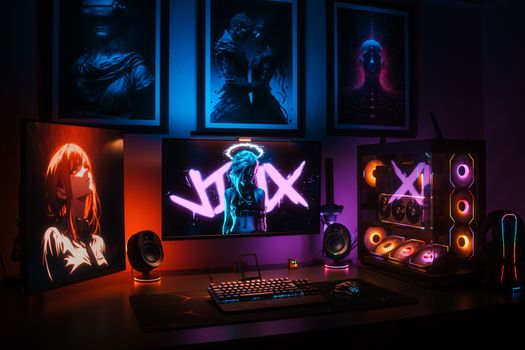
This isn't a game. It's a custom PC build stuffed with screens—Lian Li fan displays, nine smaller panels, and larger screens powered by three Raspberry Pi units—cycling 15,000+ animated GIFs across a 13.5-hour loop. Redditor Several-Bar-6512 spent "countless hours" curating over 17,000 GIFs, culling duplicates and thematically similar clips, then randomizing their sequence to prevent visual clustering. The smaller displays pull from microSD cards; the Pi units handle the heavy lifting. Nothing touches the gaming PC's actual compute.
The build went viral because it represents something specific: the point where PC customization stops being about performance and becomes pure, overwhelming expression. Most "showpiece" rigs still signal something practical—better cooling, cleaner cable management, RGB sync that proves you spent money. This one abandons that contract entirely. The screens don't display temps, FPS, or system stats. They just... show GIFs. Forever.
The Real Systems Behind the Spectacle
Here's what actually makes this work, and what gets misunderstood.
The compute offload is the clever part. Nine small displays run autonomously from microSD; three Raspberry Pis manage the larger screens. The gaming hardware itself does zero GIF rendering. This matters because it reveals the build's actual engineering priority: preserving system functionality while maximizing visual chaos. Several-Bar-6512 could have run everything through the main GPU. They didn't. That choice kept the rig usable as a gaming machine rather than converting it into a $3,000 GIF player.
The curation labor is the hidden cost. "Countless hours" downloading, then organizing, then deliberately scrambling sequences to prevent topical clumping. This is where most copycat builds would fail. Random placement isn't actually random—it's anti-random, designed to break patterns the human eye would find monotonous. The 13.5-hour loop length isn't arbitrary either; it exceeds typical waking use, so repeat viewers (or the owner) won't memorize the sequence.
The power and thermal implications are usually underestimated. Lian Li screen fans already draw more than standard PWM units. Adding nine auxiliary displays plus three Pi boards changes case airflow, cable density, and heat soak patterns. The "fish tank" case style helps here—open airflow, no solid panels trapping radiation—but also means every component lives in a glass terrarium of its own waste heat.
| Component | What It Actually Does | Common Misconception |
|---|---|---|
| MicroSD displays | Autonomous playback, zero host load | "They must drain GPU resources" |
| Raspberry Pi trio | Dedicated GIF servers for large screens | "The main PC renders everything" |
| Randomized naming | Prevents thematic clustering | "It's truly random playback" |
| 13.5-hour loop | Exceeds typical daily use window | "Longer is always better" |
What to Actually Learn From This Build
If you're considering something similar—whether full replica or partial homage—prioritize in this order.
First: power budget before pixel budget. Map actual wattage for every screen, Pi, and fan controller. The GIFs themselves are lightweight; the infrastructure to show them isn't. A rig that thermal-throttles because you added 40W of display hardware defeats its own purpose.
Second: content pipeline over hardware acquisition. Several-Bar-6512's 17,000-to-15,000 curation ratio suggests roughly 12% attrition from download to deployment. Your ratio will likely be worse. GIF sourcing, deduplication, format standardization, and sequence randomization take exponentially more time than plugging in screens. Budget 3-4 hours per hundred final GIFs if you're doing quality control.
Third: the case is the actual constraint. Fish tank cases look optimal for this application but introduce specific problems: dust accumulation without positive pressure, GPU sag from visible heavy components, and the psychological pressure to fill every visible space. A traditional case with strategic window placement often yields cleaner results with less maintenance burden.
The trade-off matrix looks like this. More screens = more immediate visual impact but higher failure points, more cable management, and faster dust buildup. Fewer, larger screens = cleaner aesthetic, easier maintenance, but less of the "overwhelming collage" effect that makes this build distinctive. There's no optimal point; there's only your tolerance for maintenance versus your desire for spectacle.
Why This Keeps Circulating (And What That Means)
The build resurfaces because it sits at a specific cultural intersection: PC hardware as identity statement, internet nostalgia as aesthetic, and the ongoing arms race for social media shareability. It doesn't benchmark well. It doesn't "make sense" by traditional build logic. That's precisely why it propagates.
For actual builders, the lesson isn't replication. It's recognizing when your project has shifted from optimization to art—and adjusting your criteria accordingly. Several-Bar-6512's rig isn't a better gaming PC for having 15,000 GIFs. It's a worse one by every conventional metric, and that's intentional.
The one thing to do differently: before adding any display element to your build, define whether it's serving function, form, or pure expression. Mixing categories without clarity produces expensive disappointment. This build succeeds because every element serves exactly one purpose, pursued without compromise.