Six employee-exclusive gifts, NT$2,200 each, and the one rule you can’t break — TSMC’s corporate merch program explained.
TSMC employees can now buy six limited-edition company-branded items — including the exact ASO sneakers CEO C.C. Wei wore at last year’s sports meet and a Tatung rice cooker with a wafer-shaped steaming plate — all priced at NT$2,200 ($70). The program, announced via the TSMC Welfare Committee website, is not a free giveaway but a self-funded purchase option. It is the most publicized merchandise drop in the chipmaker’s history, and it raises a question most tech companies never face: Is a wafer-shaped steaming plate worth the resale ban?
The six options include the now-iconic sneakers (modelled by Chairman C.C. Wei himself in November 2025), a co-branded Tatung rice cooker with a circuit-board motif, an Eminent carry-on suitcase, and three other items that have not been fully disclosed. Each is limited-run and, per the Welfare Committee, strictly for personal use — no resale, no gifting to non-employees, no commercial use.
The Six Self-Funded Gifts: Entity → Mechanism → Outcome
The TSMC Welfare Committee, the entity that manages employee benefits, launched the program as a morale and culture play. The mechanism: employees order through an internal portal, pay NT$2,200 per item, and receive a branded product. The intended outcome: internal brand alignment and limited-edition status that rewards tenure — not profit.
Yet the collectability mechanism subverts the explicit rule. Previous TSMC merchandise (older T-shirts, caps, pins) has sold on secondary markets for 2–5x the original price. The shoe’s model ID (ASO sneaker, same as Wei’s) and the rice cooker’s wafer plate are specific identifiers that drive demand. Outcome: a high-resale-value item that employees cannot legally resell — creating friction between ownership and economic opportunity.
Why a Rice Cooker with a Wafer-Shaped Steaming Plate?
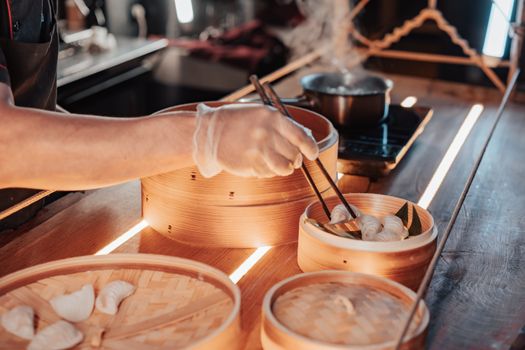
Tatung, a Taiwanese appliance maker, partnered with TSMC to create the cooker. The steaming plate is round, wafer-sized, and printed with a circuit-diagram pattern. The lid carries a mirrored silver TSMC logo. It’s a two-metaphor object: home-cooking pride and semiconductor symbolism. The mechanism is straightforward — a dated, limited co-brand — but the outcome is deeper. It transforms a household appliance into a workplace identity badge. In Taiwan, where TSMC is a national icon, that badge carries social weight.
Decision archaeology: Why not a simple cash bonus? Cash is fungible, forgettable. A branded rice cooker is sticky. The alternative would be a gift card (low sentimental value) or a generic premium (no brand reinforcement). TSMC’s choice to go bespoke, with CEO footwear as a centrepiece, scores higher on employee recall and social media lift. The trade-off: administrative friction (limited runs, enforcement of non-resale clause) and the risk of a black market the company can’t fully police.
Who Wins and Who Loses
Winner: the TSMC employee who values status signalling in a non-cash form. The shoes and rice cooker are conversation starters inside the fab and out. For the collector, the eventual scarcity could triple the item’s value — assuming they ignore the prohibition. Losing: TSMC’s own compliance team. The Welfare Committee statement is clear but unenforceable at scale. Resale on platforms like Shopee or Facebook Marketplace will happen; the company will need to risk employee backlash to prove the rule matters. Loser: the casual employee who just wanted a decent pair of shoes without the hype tax. NT$2,200 is not cheap for a branded sneaker — comparable to mid-range ASO models — but the resale prohibition means they also can’t recoup the cost later.
Anti-consensus wedge: The SERP consensus (based on initial news coverage) frames this as a cute, quirky HR initiative. The hidden variable is the enforcement gap. TSMC explicitly bans resale, but the same mechanism that creates collectibility (limited runs, CEO association) incentivises violation. This is not an employee perk — it’s a test of internal policy rigidity against real market forces. The company is betting that loyalty > arbitrage. That bet is falsifiable: if resale listings spike within 60 days of the drop, the program failed its own rules.
Beginner Guidance for the New TSMC Employee
- Do not immediately resell. The Welfare Committee monitors listings. A violation can lead to loss of future gift eligibility or disciplinary action.
- Choose the item with the most personal utility. The suitcase (Eminent) and rice cooker (Tatung) are practical gifts with brand value. The shoes are the conversation piece but may not suit daily wear.
- Check the sizing. ASO sneakers run small — confirm fit before ordering.
- Document the serial number. If you plan to keep the item, registration (if offered) helps with warranty and provenance.
- Ignore the hype. The wafer plate is a gimmick — it works as a steaming plate, but a standard bamboo steamer is cheaper and equally effective.

FAQ
What exactly is the wafer-shaped steaming plate?
A round, flat perforated disc that fits inside the Tatung rice cooker, designed to steam dumplings, vegetables, or fish. The pattern evokes a semiconductor wafer — complete with circuit-like lines — but functionally it's a standard steamer tray.
How do employees order?
Through the internal TSMC Welfare Committee online store (employee login required). The six items are posted as a single shipment per order. Payment is deducted from payroll or via company wallet.
Why only six items?
The Welfare Committee rotates gift selections quarterly. This is the June 2026 cohort. Future drops may include different items. The limit to six keeps production manageable and scarcity high.
The Bottom Line on TSMC’s Merch Play
The shoes and rice cooker are not a joke — they are a calculated culture investment from a company that knows its workforce equates brand loyalty with personal identity. The alternative (cash bonus) would not generate social media virality, news coverage, or the sense of exclusive belonging that a wafer plate creates. Trade-off: TSMC gains authenticity and internal pride, but loses control over the inevitable gray market. If you are an employee, buy the item that fits your life, not your feed. The best for most: the suitcase or rice cooker. Skip the shoes unless you actually want to walk in the CEO’s footsteps — literally.
Final verdict: TSMC’s gift program works as culture glue, but the resale rule is the weakest link. Employees should treat it as a perk with strings attached, not a flip opportunity. The hidden variable — enforcement cost vs. value capture — will determine whether this becomes a lasting tradition or a one-off PR win.