Warhammer Age of Sigmar Beginner's Guide - Tips & Tricks
Introduction
Warhammer Age of Sigmar is a tabletop miniature wargame set in a sprawling, high-fantasy universe of mortal realms, god-kings, and endless war. Unlike a board game with a fixed map and cardboard tokens, Age of Sigmar (often abbreviated as AoS) requires you to build, paint, and command your own army of highly detailed plastic miniatures on a physical tabletop. It is a hobby that blends tactical gameplay with creative expression, offering a deeply rewarding experience that can span years. This guide covers everything a complete beginner needs to know to transition from curious observer to active general on the tabletop.
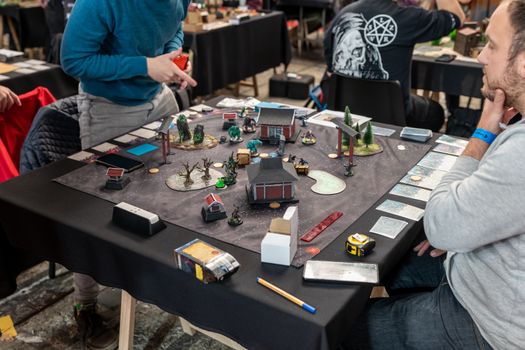
Foundations
Before you roll a single dice, you need to understand the fundamental pillars of the game. Age of Sigmar is built on a few core concepts: the miniatures, the tabletop battlefield, the dice, and the measurements.
The Core Loop of Play
A standard game of Age of Sigmar is played over a series of Battle Rounds. Each round consists of three distinct phases that both players execute simultaneously or alternate between, depending on the phase:
- Command Phase: This is the phase for pre-battle planning. Players gain Command Points (CP), which act as a currency to trigger powerful special abilities called Command Abilities. You also assign artifacts of power, invoke battle traits, and determine army-wide buffs here.
- Movement Phase: You move your units across the battlefield. Each unit has a Move characteristic in inches. You measure the distance a unit can move using a tape measure. Units can run (adding their dice roll in inches to their move but forfeiting shooting later) or retreat (moving away from enemies but also forfeiting shooting and charging).
- Shooting Phase: Units equipped with missile weapons fire at the enemy. To do this, you check the range, roll to Hit, roll to Wound, the opponent rolls to Save, and finally calculate damage. We will break down this sequence in detail later.
- Charge Phase: To fight in melee, you must declare a charge against an enemy within 12 inches. You roll two six-sided dice (2D6); the result is the maximum distance you can move. If the roll is high enough to reach the enemy, the charge is successful. If it fails, the unit does not move at all.
- Combat Phase: Melee units fight. You alternate choosing units to fight with, starting with the player whose turn it is. Pile-in moves (moving models up to 3 inches to get closer to enemies) and attacks happen here. Once all units have fought, the phase ends.
- End Phase: At the end of the round, players score Victory Points based on the scenario, battleshock tests are taken to see if fleeing units run away, and any end-of-round abilities resolve.
The Dice Mechanics
AoS uses standard six-sided dice (D6). Understanding the language of the dice is crucial. You will frequently see terms like 3+ or 4+. This simply means you must roll that number or higher on a D6 to succeed. A 3+ means a roll of 3, 4, 5, or 6 is a success (a 66% chance). Modifiers can shift these numbers; if you have a +1 to hit, a 3+ becomes a 2+. However, a natural roll of 1 always fails, and a natural roll of 6 always hits, regardless of modifiers.
The Attack Sequence
Whether you are shooting a bow or swinging a sword, the attack sequence is identical. Memorize these four steps:
- Hit Roll: Roll dice equal to the number of attacks the weapon has. You succeed on the weapon's Hit characteristic (e.g., 3+).
- Wound Roll: Take the successful hits and roll again. Compare the weapon's Rend and Damage to the target's Wounds characteristic on their warscroll to find the required Wound roll (e.g., 4+).
- Save Roll: The defender rolls for each successful wound. They use their Save characteristic, subtracting the attacker's Rend (e.g., a Save of 4+ against a Rend of -1 becomes a 5+). If they fail, they take damage.
- Damage: Each failed save results in the weapon's Damage characteristic being allocated to the defending unit. If a model's remaining Wounds drop to 0, it is slain and removed from the table.
Battleshock
War is terrifying. At the end of the turn, you must test every unit that has suffered casualties. Roll 2D6 and add the number of models the unit lost that round. If the total equals or exceeds the unit's Bravery characteristic, the unit suffers Battleshock. You then remove one model from the unit for every point the roll exceeded the Bravery score. This mechanic punishes heavy losses and can cause elite, low-model-count units to evaporate if they are unlucky.

Early Game Strategy
When you first step into the Mortal Realms, the sheer volume of choices can be paralyzing. Your first priority should not be winning tournaments, but building a solid foundation for your hobby experience.
Choosing Your First Faction
Do not choose a faction based solely on how powerful they are on the internet. "Tier lists" change with every edition and rules update. Instead, choose based on three factors:
- Aesthetics: Do you think the models look cool? You will spend dozens of hours staring at these miniatures while painting them. If you do not like how they look, you will burn out.
- Lore: Read a few short stories or watch lore videos on YouTube. Do you connect with the brooding Stormcast Eternals, the scheming Skaven, or the brutal Orruks?
- Playstyle: Do you want a massive horde of cheap models, or a small, elite strike team? Do you prefer fast cavalry, powerful magic, or resilient gunlines?
For absolute beginners, factions like the Stormcast Eternals, Orruk Warclans, or Skaven are highly recommended because they have robust starter sets, forgiving playstyles, and wide model ranges.
The Smart Way to Buy
The biggest trap new players fall into is buying a massive 2,000-point army all at once. Do not do this. Start with an Aspect of War box (the new starter sets for 4th Edition) or a smaller "Start Collecting" style box. Build and paint those models. Play a few small skirmish games at 500 or 1,000 points. This teaches you the rules incrementally and prevents you from being overwhelmed by an unpainted mountain of plastic.
Understanding Points and Army Building
Armies are balanced using a points system. Every unit, enhancement (like a magical weapon), and battalion has a points cost. A standard game is played at 2,000 points. When building an army, you select units from your faction's "Battletome" (the rulebook specific to your faction). You must ensure your army meets the "Battle Formation" requirements, which usually dictate a minimum number of Hero units and Core units (the standard troops of your army). Using official army-building websites or apps is mandatory here to avoid math errors.
Scenario Play over Annihilation
In the early days of tabletop wargaming, the goal was simply to kill all the enemy models. In modern Age of Sigmar, this is a surefire way to lose. The game is entirely objective-based. You win by holding territory, securing specific points on the map, or escorting objectives across the board. When building your list and moving your models, always ask yourself: "How does this help me score Victory Points?" A cheap unit of 10 grots sitting on an objective will win you more games than a 300-point monster chasing enemy heroes.

Mid Game Transition
Once you have played a handful of games at 1,000 points and understand the core phases, you are ready to transition into the mid-game. This is where you expand your collection, refine your painting skills, and begin to understand the deeper tactical layers of the game.
Expanding to 2,000 Points
Moving to a full-sized army requires you to fill out your Battle Formation. Look at the units you already have. Do you lack board control? Add a cheap battleline unit to sit on objectives. Are your heroes getting sniped by enemy artillery? Add a screen of disposable infantry to protect them. Mid-game army building is about identifying the weaknesses in your 1,000-point list and patching them with targeted purchases, rather than randomly buying models you think look fun (though that is still allowed!).
Mastering Command Points and Enhancements
At lower point levels, Command Points (CP) feel abundant. At 2,000 points, they are a scarce resource that dictates the flow of the game. You start the battle with 1 CP and gain 1 at the start of each subsequent Command Phase. You must learn to budget your CP. Spending 1 CP to reroll a charge might win you a fight, but if you needed that CP later to interrupt a crucial combat sequence, you will lose the game.
Enhancements are powerful items or abilities you assign to your Heroes at the start of the game. Do not just give the "best sword" to your biggest general. Give defensive enhancements to heroes whose sole job is to cast spells and buff nearby units, and give offensive enhancements to heroes designed to assassinate enemy leaders.
Understanding Melee Pile-in Tactics
The mid-game is where you must master the Pile-in move. When a unit fights in the Combat Phase, each model can move up to 3 inches, provided they end up closer to an enemy model than they started. This is not just a straight line. By using this 3-inch movement cleverly, you can "hook" around enemy models to get into base contact with a different unit, bringing multiple enemy units into the combat. This prevents an opponent from using their other units to score objectives in their next turn because they are now tied up in melee. This technique, often called "tri-pointing" or "bagging," is the hallmark of a competent intermediate player.
Screening and Board Control
You will quickly encounter enemies who can teleport across the board or charge from 12 inches away with incredible speed. To counter this, you must learn to screen. Screening involves placing a cheap, expendable unit roughly 6 to 8 inches in front of your valuable units. When the enemy charges, they are forced to stop 3 inches away from the screen. Because they cannot move through enemy models, your valuable backline is safe from melee attacks for that turn, giving you a turn to shoot the threat down or counter-charge.

Optimization Tips
As you prepare for your first local tournament or matched-play event, you will want to optimize your gameplay and your hobby time. Efficiency is the key to enjoying the game at a higher level without suffering from burnout.
Speed Painting Techniques
You do not need to paint every miniature to a Golden Demon standard to have a beautiful army. Tournament organizers require models to be painted to a "three-color minimum" standard, but you can achieve stunning results quickly. Adopt the "Slapchop" method: prime your models black, drybrush them heavily with a light gray or white, apply a single wash (like Agrax Earthshade or Nuln Oil), and then pick out a few details (weapons, eyes, bases) with base paints. This technique can finish a 20-model unit in under two hours and looks fantastic on the tabletop from three feet away.
List Building Synergies
Optimized armies do not consist of independent units doing their own thing; they are webs of synergies. When building a list, identify your "anvil" (a highly resilient unit that holds the center of the board) and your "hammer" (a high-damage unit that deals the killing blow). Then, select Heroes whose abilities specifically buff those units. If your faction has a wizard that gives a +1 to hit aura, place that wizard exactly where your hammer unit will be fighting. Do not take a melee buff wizard if your army is entirely composed of archers.
Pre-measuring and Threat Ranges
Unlike some older games, Age of Sigmar allows you to measure distances at any time. Use this to your advantage. Before you move a unit, measure exactly how far it is to the objective. Calculate your threat ranges precisely: if your unit has a 6-inch move, runs (averaging 3.5 inches), and charges (averaging 7 inches), their maximum threat range is 16.5 inches. Keep your units exactly 17 inches away from the enemy if you want to be safe, or exactly 15 inches away if you want to guarantee a charge on your next turn. Stop guessing and start calculating.
Timing Your Combats
In the Combat Phase, the player whose turn it is picks the first unit to fight. A common novice mistake is immediately selecting their most powerful unit. Instead, look at the board state. If your powerful unit is safe and going to strike last anyway, select a weaker unit first to force the enemy to reveal their combat tricks. If you have a unit that can "fight on death," use it early to soak up enemy attacks, deal damage, and then strike again when it dies. Controlling the sequence of combat is one of the most powerful tactical tools available to you.
Community Resources
Warhammer Age of Sigmar is a massive, global hobby, and you do not have to navigate it alone. Leveraging community resources will drastically accelerate your learning curve and connect you with fellow hobbyists.
Digital Army Builders
Never build an army on paper. Use dedicated army-building websites. Warscroll Builder is the official, free tool provided by Games Workshop and is updated simultaneously with new rules. AoS Reminders is another essential site; you input your army list, and it generates a customized PDF of all your abilities, spells, and enhancements so you never have to flip through a battletome during a game. Third-party apps like BattleScribe are also widely used in local gaming stores.
Visual Learning on YouTube
Reading a rulebook can be dry. YouTube is the absolute best place to learn Age of Sigmar visually. Channels like The Ninth Realm, Sunna Art, and Goonhammer offer battle reports, tactics breakdowns, and painting tutorials. If you want to understand how a specific faction plays, search for a "beginner's guide to [Faction Name]" video. Watching experienced players move models, measure ranges, and execute combat sequences will teach you more in an hour than reading rules text for a week.
Local Gaming Stores and Clubs
The heart of the Warhammer hobby is your local gaming store (LGS) or wargaming club. These communities are almost universally welcoming to newcomers. Store owners and community leaders will happily play "teaching games" with you, where they pause the action to explain why they are doing something. Look for stores that host "Path to Glory" events (a narrative, campaign-based format perfect for beginners) or casual, low-point skirmish nights before jumping into competitive tournaments.
Official and Fan Rules Communities
For rules clarifications, the Warhammer Community website publishes regular FAQ documents that override printed rules—these are mandatory reading for any player. For discussions, theory-crafting, and list critiques, the Age of Sigmar subreddit (r/ageofsigmar) is incredibly active. If you prefer Discord, there are massive servers dedicated to specific factions where veteran players will critique your lists and offer painting advice. Finally, check out competitive event results on sites like Best Coast Pairings to see what the top players in the world are actually taking to tournaments, giving you a baseline for what optimized play looks like.