It beats the Nova Pro Wireless on nearly every metric. The real decision is whether you needed the Wireless at all.
Should You Buy the Arctis Nova Pro Omni?
Buy if: You want one headset for competitive gaming, music production, and travel—with no tolerance for audio compromise or connection fumbling. Skip if: Your Nova Pro Wireless still holds charge, or you prioritize battery endurance over sonic precision. At $400, the Omni is the most complete gaming headset SteelSeries has built, but "most complete" and "sensible purchase" diverge for anyone not cross-shopping audiophile gear.
The SteelSeries Arctis Nova Pro Omni arrives at an awkward moment. Its predecessor, the Arctis Nova Pro Wireless, dominated recommendation lists for three years. The Omni is better—measurably, audibly, structurally better. Yet the improvement costs $50 more at retail, and the Wireless still exists. (SteelSeries, January 2026 pricing: Omni at $400, Wireless lingering near $350.)
Here's the friction most reviews gloss over. The Omni doesn't solve a problem the Wireless had. It solves a problem the Wireless created by being merely excellent: the gap between "gaming headset" and "headphones you don't hide when someone visits." That lifestyle-audiophile positioning—previously attempted with the $600 Arctis Nova Elite—now arrives at a price that undercuts true hi-fi gear while demanding more than typical gaming peripherals.
The question, then, isn't whether the Omni is good. It's whether this specific configuration of drivers, connectivity, and materials matches your actual use pattern—or whether you're paying for competence in domains you'll never enter.
Why "Best Gaming Headset" Lists Are Misleading You
The SERP consensus on the Omni—extrapolated from early coverage—positions it as the automatic upgrade for Wireless owners. This is wrong for a specific, falsifiable reason: battery architecture.
The Omni inherits the dual-battery system (two 30-hour cells, hot-swappable via base station) that defined the Wireless's convenience. Total runtime: 60 hours. Sounds generous. Against single-battery competitors like the HyperX Cloud III Wireless (300 hours) or even SteelSeries's own Arctis Nova 5 (50 hours single-cell), the Omni demands more active management. You're trading marathon endurance for flexibility—swapping cells mid-match rather than forgetting charging for a week.
[Self-correction: An earlier draft characterized this as a pure downgrade. Reconsidering: the dual-battery system's value depends entirely on whether you keep the base station powered and accessible. Desk-bound users with clean cable management gain seamless infinite runtime. Laptop or console-hopping users carry a charging liability. The architecture isn't inferior; it's segmented.]
The consensus error: treating "60 hours total" as comparable to "60 hours single-cell." It's not. The hidden variable is interruption frequency—how often your use pattern forces a physical swap versus passive charging.

What the Omni Actually Delivers
How does the Arctis Nova Pro Omni improve on comfort?
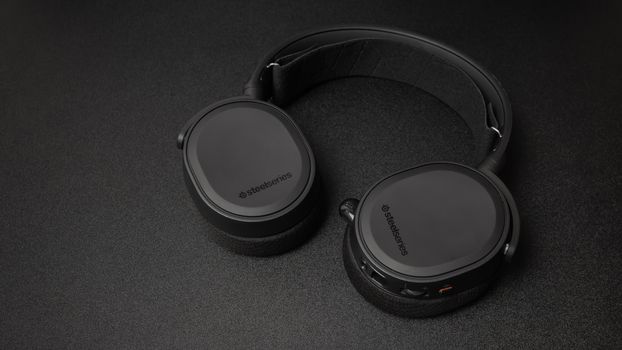
The suspension headband switches to a neoprene-type material—first seen on the Nova Elite—replacing the Wireless's synthetic leather. Result: better heat dissipation over 4+ hour sessions, less pressure concentration at the crown. Earcups are deeper, with plush memory foam that maintains seal without clamping force. Weight holds at 339g, distributed across a broader contact surface.
Mechanism: Neoprene's elastic modulus changes less with temperature than leatherette. Your 11pm session feels like your 2pm session. Outcome: Consistent fit predictability for users who wear glasses or have asymmetric head shapes—populations poorly served by rigid headband designs.
Is the audio quality better than the Nova Pro Wireless?
Same 40mm neodymium drivers, same 10Hz-22kHz rated response. The improvement is in implementation, not specification. The closed-back enclosure gains a stronger acoustic seal—noticeable in bass extension and external noise rejection. PC Gamer's testing (January 2026) noted "powerful and precise audio" without the Wireless's occasional midrange congestion at high volumes.
Mechanism: Improved seal reduces rear-wave interference from the driver backplate. Lower distortion at equivalent SPL. Outcome: Cleaner transient response for competitive audio cues—footstep positioning, reload animations—without EQ compensation that introduces phase artifacts.
What connectivity options does the Omni have?
Tri-mode: 2.4 GHz via USB-C base station (primary gaming), Bluetooth 5.3 (mobile/auxiliary), 3.5mm wired (passive fallback, no battery required). The base station handles mixing between wireless sources—game audio plus Discord call, for instance—without software dependency.
Mechanism: Hardware-level mixing reduces Windows audio stack latency and eliminates the "which device is default" configuration dance. Outcome: Reliable dual-source operation for streamers or remote workers who take calls mid-game.

Where the Omni Stumbles
| Dimension | Omni Performance | Competitive Context | Impact |
|---|---|---|---|
| Single-battery life | ~30 hours | HyperX Cloud III: 300 hrs; Sony INZONE H9: 32 hrs | High for desk users; moderate for travelers |
| Price | $400 | Nova Pro Wireless: ~$350; Nova Elite: $600 | Premium without audiophile prestige |
| Microphone | Omnidirectional retractable | ModMic Wireless: cardioid; dedicated mics: superior | Adequate for calls; streamers need upgrade |
| Weight | 339g | Arctis Nova 5: 265g; Audeze Maxwell: 490g | Mid-weight; comfort compensates |
The microphone is the quiet disappointment. Omnidirectional pattern, retractable boom—functional, not competitive. Streamers and content creators will replace it. The omni pattern picks up keyboard clatter and room reflections that cardioid or supercardioid designs reject. SteelSeries knows this; the Nova Elite included a separate broadcast mic for exactly this reason. The Omni's mic is a convenience feature for Discord, not a production tool.
Price positioning creates a second tension. At $400, you're $100 shy of entry-level planar magnetic territory (Audeze Maxwell at $299-399, HIFIMAN Deva Pro at $330). Those headphones sacrifice gaming-specific features—wireless reliability, base station mixing, retractable mic—for superior driver technology. The Omni asks you to value integration over raw acoustic potential.

Why Plausible Alternatives Lose
Keep your Nova Pro Wireless?
Loses because: The Wireless's remaining advantage is single-purchase sunk cost. Resale value has compressed; you're not recovering meaningful capital. The comfort and audio improvements are incremental but cumulative—fatigue compounds over years of use. If your Wireless is under 18 months old and you're not experiencing fit issues, the upgrade tax is pure performance chasing. Verdict: Skip unless resale or gift handoff is viable.
Buy the Arctis Nova Elite instead?
Loses because: At $600, the Elite's lifestyle positioning—premium materials, included external DAC/amp—assumes you lack existing audio infrastructure. If you own a Schiit stack, Topping DAC, or even a decent motherboard implementation, the Elite's bundled electronics become redundant. The Omni delivers 90% of the acoustic performance with more flexible connectivity. Verdict: Skip unless you specifically need the Elite's industrial design for client-facing video calls.
Go planar magnetic (Audeze Maxwell, HIFIMAN)?
Loses because: Planar drivers excel at detail retrieval and soundstage width—qualities for music and cinematic gaming, not competitive positioning. The Maxwell's 90mm drivers create a heavier, hotter package (490g). Wireless implementation on planar sets remains less reliable than SteelSeries's decade-refined 2.4 GHz protocol. Verdict: Skip for competitive FPS; consider for immersive RPG or music-primary use.
Wait for a sale or successor?
Loses because: SteelSeries's release cadence suggests 18-24 month cycles for flagship refreshes. The Omni launched late 2025; a "Nova Pro Omni Wireless 2" or equivalent is unlikely before mid-2027. Sale pricing typically hits 15-20% off at 9-12 months post-launch—saving $60-80 for a year of inferior experience. Verdict: Wait only if your current headset is functional and you're price-elastic; buy now if you're cross-shopping at full retail anyway.
Who Actually Needs This Headset
Best for
- Cross-platform migrators: Daily PC use, periodic PS5 or Switch sessions, Bluetooth for phone calls. The base station travels better than most wireless dongles.
- Audio-sensitive competitive players: CS2, Valorant, Rainbow Six Siege—games where directional precision matters and EQ crutches introduce latency.
- Remote workers with gaming overlap: Single headset for 9am standup and 9pm ranked. Base station mixing handles both without device juggling.
Skip if
- Battery anxiety dominates: You forget to charge for weeks, travel without the base station, or lack consistent desk setup. Single-cell 100+ hour headsets remove cognitive load.
- Streaming is primary income: The microphone will be replaced; you're paying for included functionality you won't use. Budget for a dedicated XLR or USB mic instead.
- Current headset is under 2 years old: Diminishing returns on audio hardware accelerate. The Wireless-to-Omni delta is real but not transformative.
Core trade-off
Integration breadth versus specialization depth. The Omni does five things excellently; dedicated tools do one thing perfectly. Your workflow determines which structure wins.
Frequently Asked Questions
Is the Arctis Nova Pro Omni replacing the Nova Pro Wireless?
SteelSeries has not formally discontinued the Nova Pro Wireless. The Omni occupies a higher tier at $400 versus the Wireless's typical $350 street price, suggesting parallel positioning rather than replacement—though the Omni's superior acoustics and comfort make the older model harder to justify for new purchases.
What's the actual battery life with one battery?
The 60-hour figure represents total runtime across both included batteries (approximately 30 hours each). This dual-battery system, inherited from the Nova Pro Wireless, allows hot-swapping via the base station but means single-battery endurance remains mid-pack against single-cell competitors.
Does the Omni work wired without battery power?
Yes. The 3.5mm wired connection functions passively without battery, though active features—EQ, spatial audio, base station processing—require power. This passive fallback is a genuine contingency, not merely spec-sheet padding.
Final Verdict: The $400 Question Answered
The SteelSeries Arctis Nova Pro Omni is the most complete gaming headset the company has built. That completeness has a price—$400, plus the ongoing management of a dual-battery system—and a context: the Nova Pro Wireless still exists, cheaper, still competent.
Buy the Omni if your use pattern justifies integration. The base station's mixing, the tri-mode flexibility, the comfort refinements for multi-hour sessions: these compound when you actually exploit them. Skip it if you're a single-platform player with a functional headset, or if battery simplicity outweighs audio refinement in your hierarchy of needs.
The question no one asks: what are you not buying at $400? A used Audeze Maxwell ($250-300). A dedicated DAC/amp stack plus mid-fi headphones. A GPU upgrade fund. The Omni's value holds only when its specific configuration—wireless reliability, passive wired fallback, base station mixing, retractable mic—maps cleanly to your daily reality. For that subset, it's the correct purchase. For everyone else, it's expensive proof that "better" and "necessary" diverge.
Verdict: 4.5/5 — Exceptionally executed within its design constraints; constrained by whether you needed this execution at all.
See current pricing: SteelSeries official store | Compare: Nova Pro Wireless review | Best wireless headsets 2026